
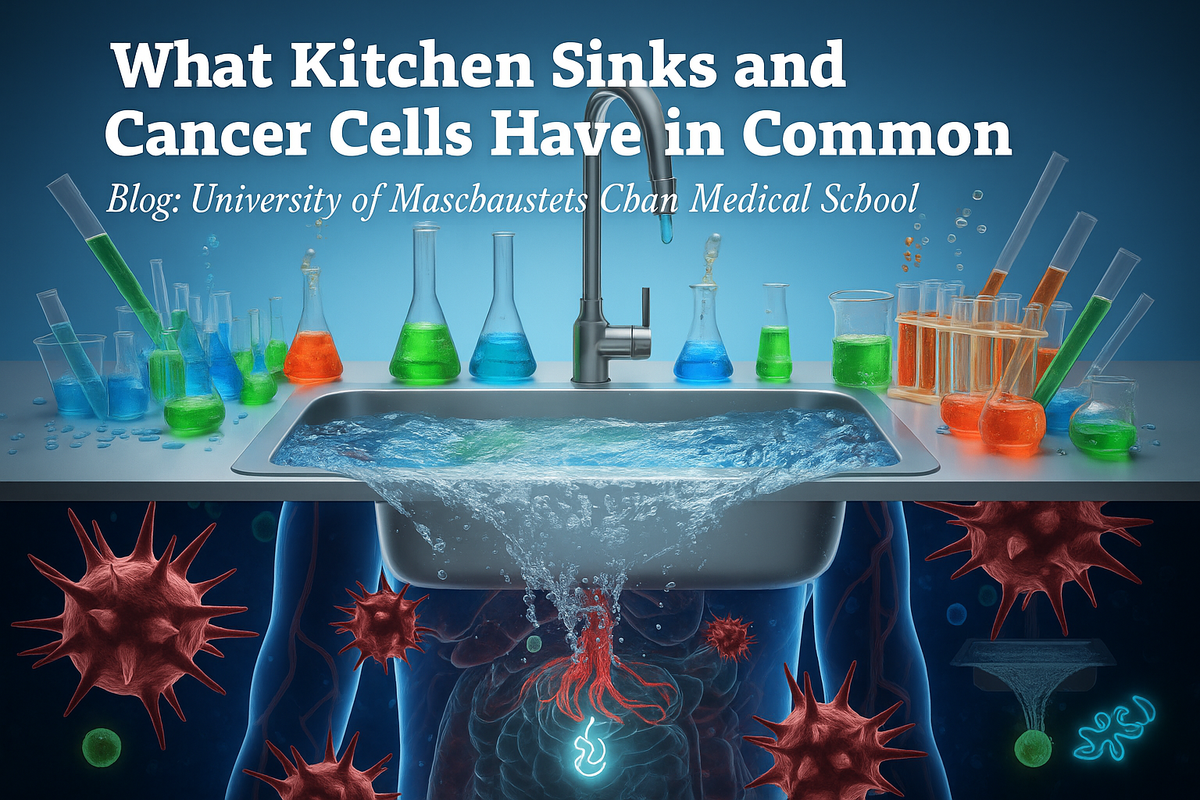
In a quiet lab at the University of Massachusetts Chan Medical School, Dr. Dohoon Kim is building a new kind of cancer treatment that starts by deliberately breaking the body.
"Cancer cells are a bit like kitchen sinks," says Dohoon Kim. It's not a metaphor you often hear in oncology, but it could be the foundation for an entirely new class of cancer treatments.
The way it work? These treatments strive to ‘flood’ cancer cells, break strategic locations of the cellular machinery that cancer depends on. It’s a big paradigm shift in the field. For a long time, we viewed metabolism like a factory production line, instead of a kitchen sink.
The body's metabolism is the set of chemical reactions that sustains life. Food comes in, gets broken down into energy, and waste gets removed. Each step consists of chemical reactions that are often complex, multi-step systems. Often, just one error can be catastrophic. Just like how a bakery with broken ovens can no longer produce bread, a metabolic pathway with broken proteins can no longer support the body.
One famous example is Phenylketonuria (PKU), a genetic disease that is screened for in all newborns. Patients affected with PKU have a mutation in the PAH protein that prevents them from processing phenylalanine, a nutrient naturally found in protein-rich foods like meat, eggs, and milk. This causes toxic levels of phenylalanine to build up in the body, causing brain damage, mood disorders, seizures, and eczema. If caught early, newborns can have normal brain development by staying on a low-phenylalanine diet. In addition, the disease can be managed with a cocktail of drugs that lower phenylalanine levels.
Lots of medical research is focused on curing inborn metabolic diseases. It's a large class of genetic diseases and presents an intuitive solution - could we find “metabolic” disorders that kill cancer, while keeping you safe?
Instead of asking how we could fix the broken machinery, Dohoon Kim wanted to use the toxic byproducts of their dysfunction. Kim visualizes each reaction in the metabolism like a kitchen sink. As enzymes catalyze each reaction, there's an inflow and outflow of metabolites, just like a tap and a drain in a sink allow water to flow in and out. Each cell has a limited capacity for toxic intermediate byproducts it can tolerate, just like how a kitchen sink can only hold so much water if the drain is clogged.
That gave way to a new question- how might we strategically overflow the sinks in a way that targets cancer cells without affecting healthy cells?
Cancers are one of the most sinister types of disease in the body. Your body consists of trillions of cells, which multiply in a very controlled way. Sometimes the cell makes mistakes when multiplying, causing changes and mutations to build up. Over time, as more mutations accumulate, controls and safeguards imposed by the body break, causing these cells to grow uncontrollably. These cells steal resources and invade and damage other parts of the body, a phenomenon we call cancer. These diseases are so tricky to fight because they come from our own cells. Because the body recognizes the cancer as one of its own, it tricks itself into giving it more nutrients and letting it grow. But the changes that let cancer grow might also be its Achilles’ heel. Cancer cells need a lot of energy because they divide very often, and therefore have different metabolisms than healthy cells. Cancer cells often revive dormant metabolic functions and scale existing metabolic machinery into overdrive. Because they grow at increased speed, they must also produce intermediate toxins at increased speed. Therefore, Kim reasoned, if we break the machinery in charge of clearing toxins out, or if we start clogging the sinks, we could make cancer cells poison themselves in their quest for growth.
One of the most notable targets the Kim lab found is UXS1. UXS1 is an enzyme involved in digesting a type of sugar, UDPGA, which is produced as an intermediate of hyaluronic acid production and other components involved in the cell structure and movement. At low levels, this sugar is harmless, but at high levels, it is toxic and messes up cell function. Some cancer cells, it turns out, produce extraordinary amounts of this sugar, making them particularly dependent on UXS1 to keep their systems flowing. Remove UXS1, and the metaphorical sinks overflow. The cell drowns from its own sugar-producing activity. In a recent study, Kim’s team used CRISPR gene editing to knock out UXS1 in both healthy and cancerous cells. The result? The cancer cells died. The healthy cells survived; they don’t produce enough of the toxin to ever get hurt.
To ensure the death blow came from the loss of the UXS1 gene and not from the reduction in hyaluronic acid production, which is important in cell movement and multiplication, the Kim lab used ELISA kits from Biomatik, which provide off-the-shelf tools for analyzing or changing cell chemistry. These kits consist of antibodies that bind to hyaluronic acid with dye to help researchers quantify how much of each protein, sugar, or other biochemical exists in their samples. They confirmed that hyaluronic acid levels stayed stable, narrowing the cause of death to toxic sugar buildup.
Dr. Kim says that a lot of what he's "discovered" has been right under our noses for years. His interest in these toxic metabolites first started during his postdoc at the Whitehead Institute at MIT while studying brain cancers and brain metabolism. There, he noticed that many of the chemicals we conventionally see as toxic, such as formaldehyde, are already produced all around the body. To find out if any of these toxins might be specific to cancer cells, Dr. Kim began diving into toxicological reports by the National Institute of Health, searching for unusual patterns in obscure biochemical byproducts. The more he looked, the more he found.
Another discovery involved selenium, which the body requires in trace amounts, but is toxic at high concentrations. While healthy cells never intake enough selenium to become toxic, cancer cells rely on proteins made of selenium to fight against oxidative damage. The Kim team discovered that, by destroying the SEPHS2 enzyme, which typically detoxifies selenium, they could destroy entire tumors without harming healthy tissues.
Another promising target is KDSR, an enzyme involved in managing lipid byproducts. Disabling KDSR leads to accumulation of sphingoid bases (fat-like molecules that become lethal when unprocessed). Again, healthy cells weather the stress. Cancer cells cannot.
Today, the Kim lab is laying the groundwork for a new body of biological molecules- the endotoxome, or toxins produced by the body. He believes that documenting a well-defined database and understanding of these chemicals could be the springboard for entirely new classes of treatments in the future. The promise is tantalizing: a suite of treatments that don’t rely on foreign chemicals, but rather on our own internal biochemistry turned against itself, like an autoimmune booby trap.
But Kim thinks we're just scratching the surface. "The most fulfilling thing in my research,” he says, “has been to look at a simple problem for a very long time." Kim hints at even further progress on the horizon with other approaches he plans to explore. "If a metabolic intermediate turns out to have unexpected toxic properties," he reasons, the observed toxicity is likely an aberrant manifestation of biological functions we’ve never discovered, which gives us yet another potential pathway for new drug systems. “It’s likely,” Kim says, “that many metabolic intermediates that we’ve written off as simply bridges to more important cellular building blocks may actually have important biological roles that we can learn from and use.”
Despite the potential, these processes are still poorly understood for now, and cures are unlikely to come for years. For example, we still don't quite understand the potential risks of these toxins spilling into other parts of the body, and solutions for how to implement these cures directly into the body don’t exist yet. For now, he and his team continue to explore and map the undocumented world of the endotoxome. Even though the field is only in its infancy, the answers to the fundamental questions Dr. Kim asks might just give us a peek into the medicine of a distant tomorrow.